
ESG Regulation
Which ESG regulations apply to you, and when?
ESG regulation
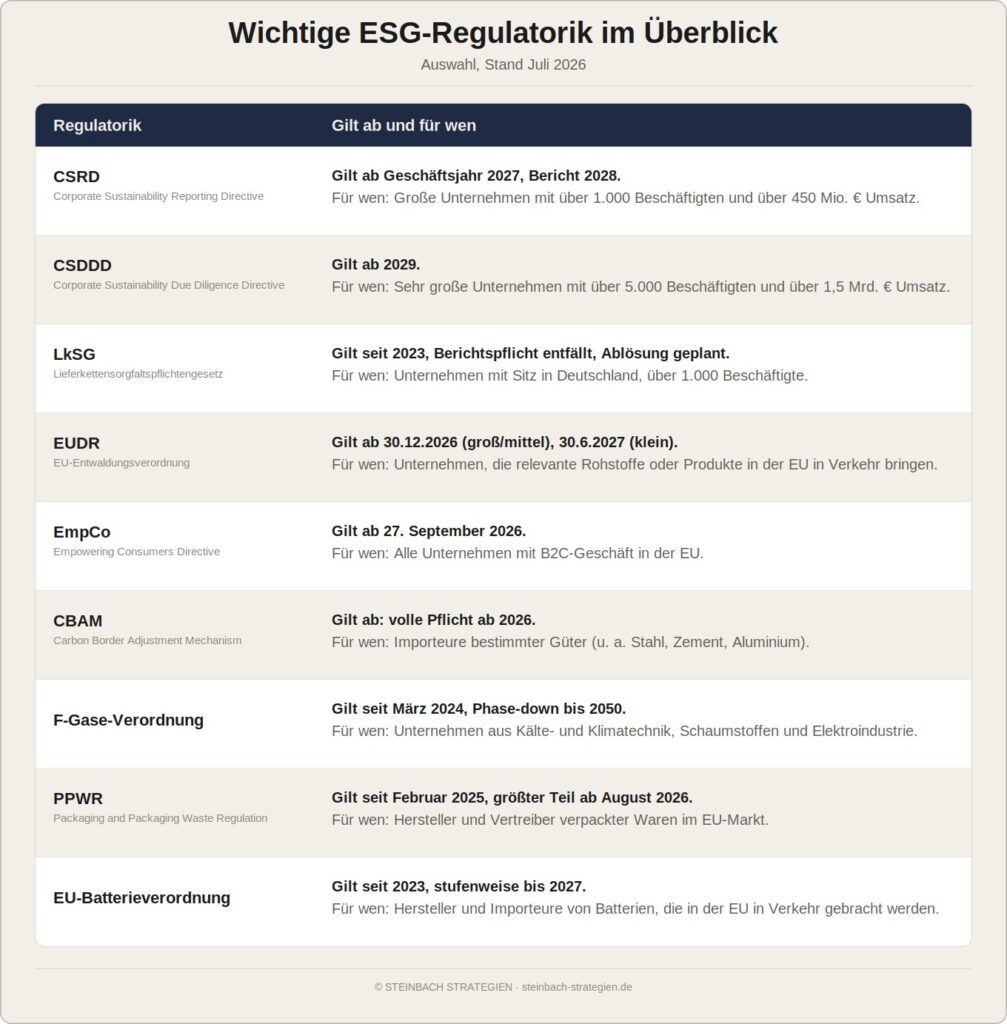
ESG regulation has become extensive and complex in recent years. Some requirements apply to virtually every larger company, such as the CSRD, the German Supply Chain Act (LkSG), or EmpCo. Others apply only to certain industries, such as the EUDR or CBAM. Relevance and timing therefore differ from company to company. STEINBACH STRATEGIEN identifies what matters and aligns ESG regulation with customer requirements as well as ratings and rankings.
Finding your way through the ESG regulatory maze
ESG regulation includes obligations for almost all larger companies, such as the CSRD, LkSG, or EmpCo, as well as obligations for specific industries, such as the EUDR or CBAM. Topics such as the PPWR or the EU Battery Regulation add to this. Orientation is key: What is relevant when, and how can it be integrated into existing sustainability management?
Climate targets and climate transition
Climate is already the most formalized ESG requirement. Under CSRD reporting, ESRS E1 covers disclosures on emissions, targets, and actions. Many companies are expected to set climate targets in line with SBTi. Customers increasingly ask specifically about product footprints and reduction targets, and EmpCo requires robust evidence for climate claims.
STEINBACH STRATEGIEN puts the various requirements on climate action and climate transition into strategic context and links them to sustainability management.
LkSG, CSDDD, and human rights due diligence
The Omnibus package has significantly eased the LkSG and the CSDDD. Under the LkSG, the annual reporting obligation no longer applies. The CSDDD now applies only from 2029 and only to very large companies. Actual requirements nevertheless remain high, often driven by customer requirements as well as ratings and rankings, regardless of the legal situation.
Biodiversity, circular economy, and EUDR
ESG regulation is growing beyond climate action, too. Biodiversity is already part of CSRD reporting, yet it remains a complex and unfamiliar topic for many companies. The EUDR adds supply chain requirements for certain commodities, regardless of the products they end up in.
The circular economy is also gaining importance, as are related regulations such as the EU Ecodesign Regulation, the EU Battery Regulation, and the PPWR. All of these topics have one thing in common: requirements need to be made concrete. That takes a strategic analysis from which suitable implementation plans can be derived, always with a view to the specific business context.
EmpCo: Which environmental claims are permitted?
The EmpCo Directive (EU) 2024/825 prohibits a range of specific practices and wording. It has been in force since March 2024 and must be applied from September 27, 2026. Germany is transposing it through an amendment to its Unfair Competition Act (UWG).
What can a company still say about its environmental performance, and which channels must be EmpCo-compliant from September 2026? This is exactly where the assessment comes in, so that the switch to EmpCo compliance succeeds in time.
More on EmpCo in our blog article (in German)
Get in touch
Questions? The best way to get started is with a brief email. We can then discuss whether a collaboration makes sense and what form it might take.