
Corporate Citizenship and CSR
Community engagement that has an impact and fits your company.
Corporate citizenship: focus strategically, create impact
Corporate citizenship, also known as CSR, is a company’s voluntary contribution beyond its core business. Many companies have been engaged for a long time, but rarely in a strategically focused way. Engagement makes an impact when it fits the sustainability strategy, the business model, and the company’s purpose. STEINBACH STRATEGIEN provides structure: defining fields of action, developing projects, using resources wisely, and making impact visible.
CSR strategy and impactful engagement
A CSR strategy builds on the company’s profile, resources, and goals. Impactful engagement requires projects that fit the fields of action of the sustainability strategy. Existing, often small projects can be bundled for greater impact, or new flagship projects can emerge. Corporate citizenship is a field with many ways to make a difference in society.
Typical tasks in corporate citizenship
- Status review: Analyzing existing engagement, for example fit, impact, use of resources, and alignment with the sustainability strategy
- Topic selection: Defining fields of action and approaches, also with a view to the engagement of comparable companies
- Concept development: Defining the strategic direction and projects
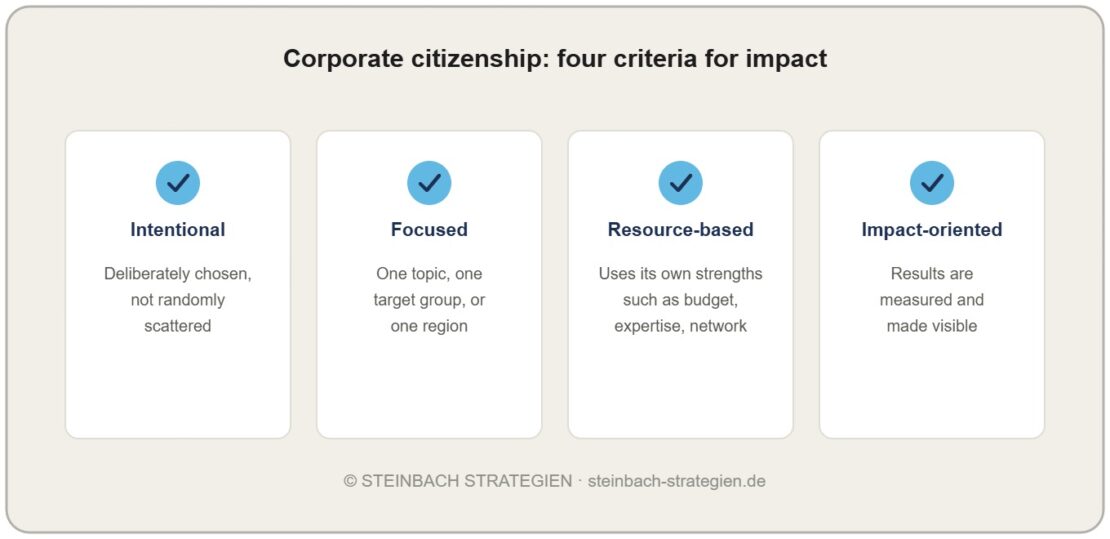
Fig.: Four criteria for strategic corporate citizenship
Developing and implementing corporate citizenship and CSR projects
The concept turns into one engagement project, or several. Whether local at company sites, linked to product brands, or as a flagship project, with or without partners: what matters is that it is set up to be effective and efficient.
Typical tasks
- Project format: Local engagement at company sites, product-related engagement such as in-kind donations, cooperation with a social or environmental organization, or matching funds
- Time horizon: One-off activity, recurring project, or multi-year program
- Choice of partners: Selecting the organization, clarifying each side’s role and contribution
- Employee involvement: Engaging employees’ working time and expertise, including through corporate volunteering
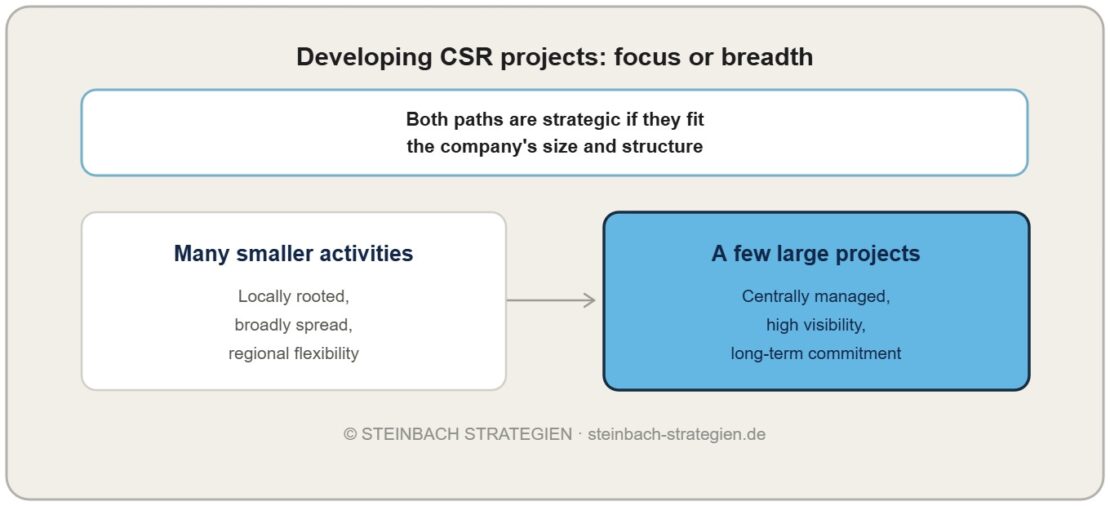
Fig.: Two ways to develop CSR projects
CSR communication: making engagement visible
Corporate citizenship becomes effective when it becomes visible, both internally and externally. The purpose of the CSR project needs to be shown and understood. Visibility only works with substance: clear facts instead of claims, real impact for society.
Typical tasks in corporate citizenship
- Project communication: Clear and credible presentation of CSR projects for different target groups
- Overall context: Linking activities to the sustainability strategy
- Proof of impact: Documenting results as the basis for credible communication
- Input for agencies: Preparing expert content for communications agencies that design the materials but are not familiar with the CSR subject matter
Frequently asked questions about corporate citizenship and CSR
CSR stands for corporate social responsibility and goes back to a 2001 EU Green Paper that refers to corporate responsibility across all business operations, from a company’s own employees to the supply chain. Today it is complemented by standards such as ISO 26000. In practice, the term is often used more narrowly, as a synonym for a company’s voluntary contribution to society, which is also called corporate citizenship, corporate giving, or community engagement. There is no single definition: an academic study counted more than 30 different understandings of the term as early as 2011. That is why it pays to clarify at the start of every project which understanding of CSR is meant.
Strategic engagement is intentional rather than reactive, focuses on one topic or target group, builds on the company’s existing strengths, and aims for demonstrable impact. Without this framework, engagement remains a collection of individual good deeds rather than a coherent contribution.
Engagement ranges from local projects at company sites and product-related engagement such as in-kind donations to partnerships with social or environmental organizations and matching funds for employee donations. Employees’ working time and expertise also count, for example through corporate volunteering.
Both can be strategic. What matters is the fit with the company’s size and structure, not the number of projects. A corporation with several sites often takes a different route than a midsize company with a single location. The time horizon also plays a role, from a one-off activity to a multi-year program with a long-term partner.
Corporate citizenship becomes effective when it becomes visible, both internally and externally. The purpose of the CSR project needs to be shown and understood. Visibility only works with substance: clear facts instead of claims, real impact for society. When done well, corporate citizenship also often holds great potential for a company’s image and for satisfaction, for example among employees and in the local community.
Get in touch
Questions? The best way to get started is with a brief email. A conversation then shows whether working together is a good fit and what it could look like.