
Sustainability Strategy
From initial setup to operationalizing your ESG strategy.
Sustainability strategy: build, measure, refine
For companies, developing a sustainability strategy often means one of three things: setting up an ESG strategy from scratch, operationalizing it with measurable KPIs, or further developing an existing strategy. This is frequently driven by CSRD requirements or rising expectations from customers and investors. Those who tackle this task with a focused approach gain resilience and scope for their own transformation. STEINBACH STRATEGIEN analyzes the current situation, identifies what is needed, and delivers.
Developing a sustainability strategy: analysis and baseline assessment
All strategic work begins with clarity regarding the starting point: objectives, structures, competitive position and external requirements.
Typical tasks
- Baseline assessment – an overview of existing objectives, measures and structures
- Benchmarking – comparison with competitors and industry leaders in transformation
- Thematic analysis – in-depth examination of individual ESG areas, such as climate, biodiversity or the supply chain
- Requirements assessment – evaluation of customer questionnaires, ratings and frameworks
- Materiality analysis – double materiality assessment in accordance with the CSRD (ESRS)
Over 20 years of consulting experience sharpen the focus on what matters: the result is a clear assessment and a concrete plan for the next steps.
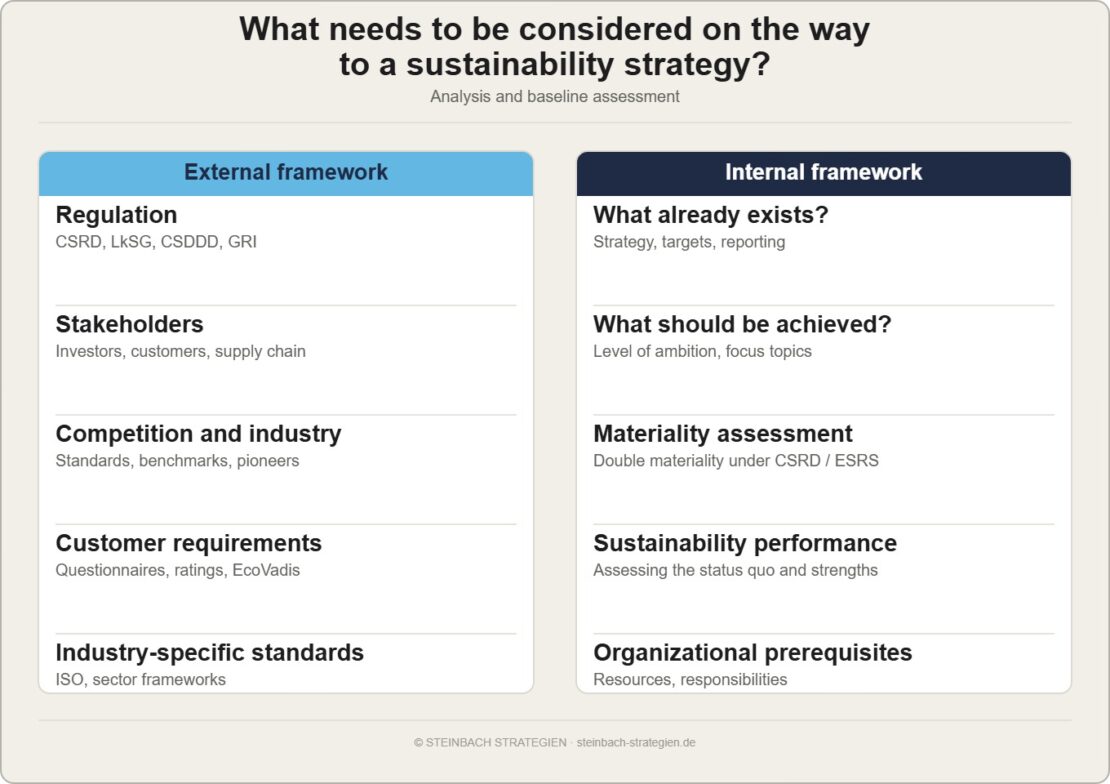
Fig.: Baseline assessment: internal and external framework conditions of a sustainability strategy
Harnessing requirements and key issues strategically
Sustainability requirements come from many quarters. Investors are asking about carbon footprints, climate targets and transformation plans. Regulations such as the CSRD or the German Supply Chain Act (LkSG) are imposing increasing demands along the supply chain. Biodiversity and human rights are emerging as key substantive issues. This is a lot to take in at once, but no company needs to meet all these requirements simultaneously. STEINBACH STRATEGIEN provides clarity on what matters and ensures that resources are deployed where they make a difference.
Typical tasks
- Stakeholder analysis – expectations of customers, investors, the supply chain and society
- Regulatory assessment – CSRD (ESRS), LkSG, CSDDD, EUDR, EU Taxonomy and other frameworks in a corporate context
- Prioritization – identification and weighting of key strategic ESG issues
- Relevance assessment – aligning market requirements with the business model and competitive position
Developing a sustainability strategy: with clear ESG targets and roles
A sustainability strategy is most effective when it starts from where the company stands: aligned with its core business, with a distinctive profile, and geared toward transformation. STEINBACH STRATEGIEN develops strategies with clear priorities, measurable targets and a transformation narrative that resonates internally and convinces externally. The CSRD (ESRS) is incorporated as a strategic context, not as a driver.
Typical tasks
- Strategy development – creating a new sustainability strategy, operationalizing an existing one, or further developing it
- Target definition – sustainability targets with measurable indicators and a timeframe
- Operationalization – translating a qualitative approach into an ESG strategy with KPIs and assigned responsibilities
- Transformation narrative – core message and narrative for credible communication
- CSRD as a framework – strategic use of the CSRD (ESRS) beyond reporting requirements, including a climate transformation plan
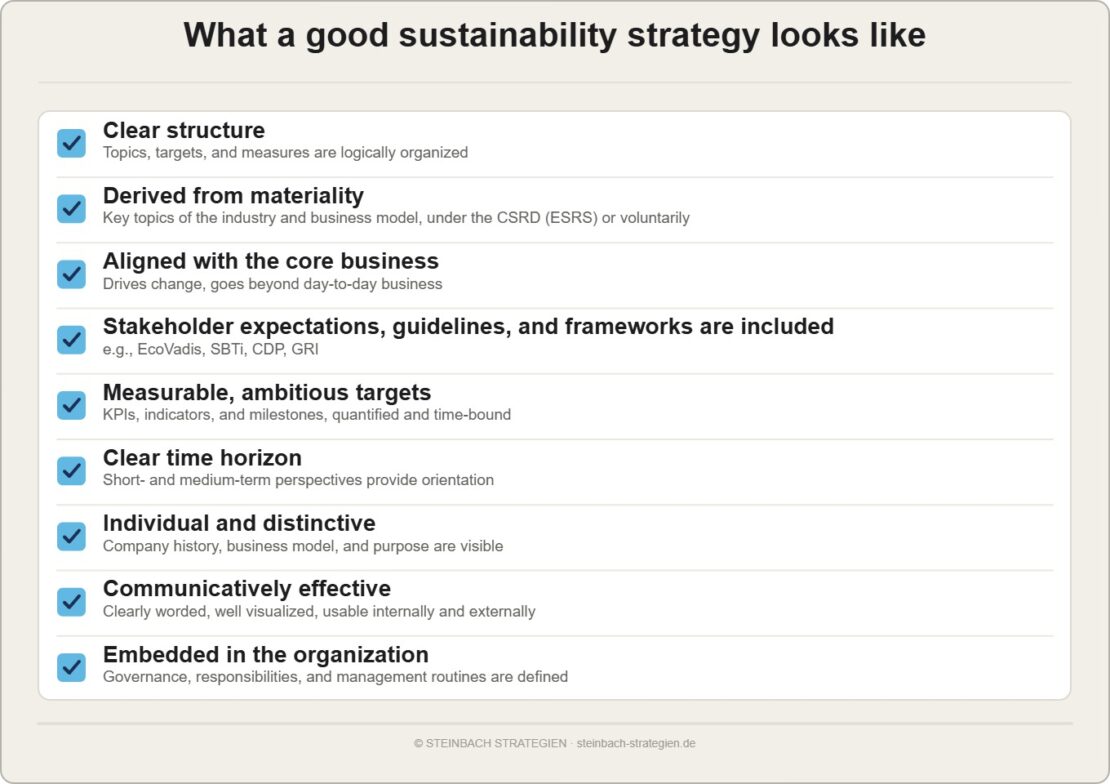
Fig.: Nine success factors of a good sustainability strategy
From strategy to implementation
Once the strategy has been developed, implementation often stalls: due to a lack of KPI-based steering, insufficient resources, or issues that fall between departmental responsibilities. STEINBACH STRATEGIEN is familiar with these stumbling blocks and works pragmatically with you to overcome them.
Typical tasks
- Implementation planning – measures, responsibilities, schedule
- Governance framework – steering structures and processes in sustainability management
- Integration – embedding sustainability targets into corporate planning
- Clarification of roles – involving relevant departments, clarifying responsibilities
- Change management – defining special projects and quick-win opportunities with milestones
The goal is independence: expertise is built up within the company, and sustainability management continues on its own afterward.
Any questions?
The best way to get started is with a brief email. A conversation then shows whether working together is a good fit and what it could look like.