
Sustainability
and ESG Reporting
From data collection to the finished report.
Sustainability reporting: meeting obligations, seizing opportunities
Sustainability reporting is mandatory for many companies and an opportunity for all. Whether a CSRD report under ESRS, a GRI report, EcoVadis reporting, or a sustainability report without a fixed framework: the requirements vary, and so do the starting points.
STEINBACH STRATEGIEN supports companies with sustainability reporting, from the initial overview through data collection to the finished report. With over 20 years of experience and a clear sense of what each situation really needs.
All about CSRD reporting requirements
Who is affected, what the ESRS require, and where things currently stand: concise, on a dedicated page.
Setting up, steering, and supporting sustainability reporting
Sustainability reporting raises several questions: Why report? Which format fits: a CSRD report under the ESRS, a GRI report, EcoVadis reporting, or another standard? What data is available, and how extensive should the report be? Is the goal an online report, a PDF, or a printed report? And who is responsible?
STEINBACH STRATEGIEN supports this process from the point that makes sense for you and in the way that fits best, with 20+ years of experience in sustainability reporting.
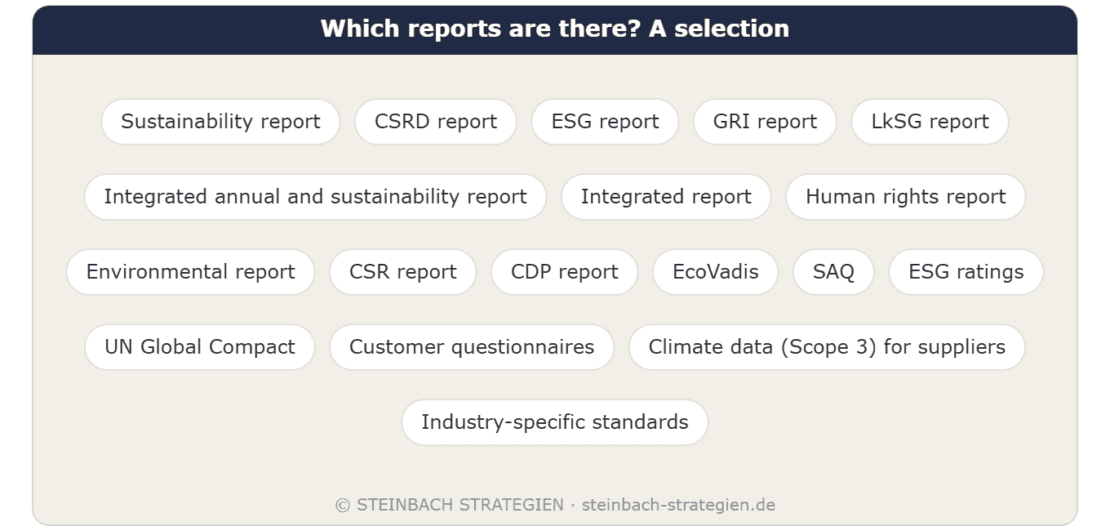
Fig.: The range of sustainability and ESG reporting requirements
Typical tasks in sustainability reporting
- Weighing report formats and frameworks: CSRD/ESRS, GRI, and other standards for voluntary reporting
- Process design: timeline, responsibilities, interfaces
- Structuring and supporting data collection
- Quality assurance and preparation for external assurance
- Sparring and steering for ongoing reporting processes
Developing and implementing sustainability reports
A sustainability report meets requirements such as the CSRD reporting obligation or customers’ demands for solid ESG data. Whether under GRI, VSME, or without an external framework: it takes a clear structure, material topics, and robust KPIs that stand up to external assurance.
STEINBACH STRATEGIEN provides support from concept to finished report, covering content, structure, and editing. The result convinces stakeholders and moves the company forward in sustainability management. How to tell a compelling story with ESG reports is described under Sustainability Communication.
Typical tasks in ESG reporting
- Developing and implementing sustainability reports under the CSRD (ESRS), GRI, VSME, and other standards
- Support with voluntary reporting
- Integrating customer requirements (questionnaires, EcoVadis, SAQ, etc.) into sustainability reporting
- Content advice, editing, and quality assurance
- Advice on integrated reporting, EcoVadis, CDP, the German Supply Chain Act (LkSG), ESG ratings, and other reporting requirements
Editing and quality assurance of sustainability reports
Many companies already have established processes for sustainability reporting. But the report itself is not yet convincing: content lacks substance, texts are hard to understand, a strategy is missing, KPIs are incomplete or unstructured. Sometimes the structures and processes for the ESG report are inefficient, or the organization is not yet prepared for external assurance.
STEINBACH STRATEGIEN reviews existing sustainability reports and gives concrete feedback on what works and what doesn’t. A professional review before publication also often helps to improve the ESG report significantly. At STEINBACH STRATEGIEN, quality assurance is part of every reporting process.
Typical tasks in sustainability reporting
- Review and analysis of existing sustainability reports and websites
- Expert feedback and concrete suggestions for improvement
- Copywriting and revision of existing texts
- Quality assurance as part of all reporting processes
- Content review for greenwashing risks and green claims
- Content and process preparation for external assurance under the CSRD
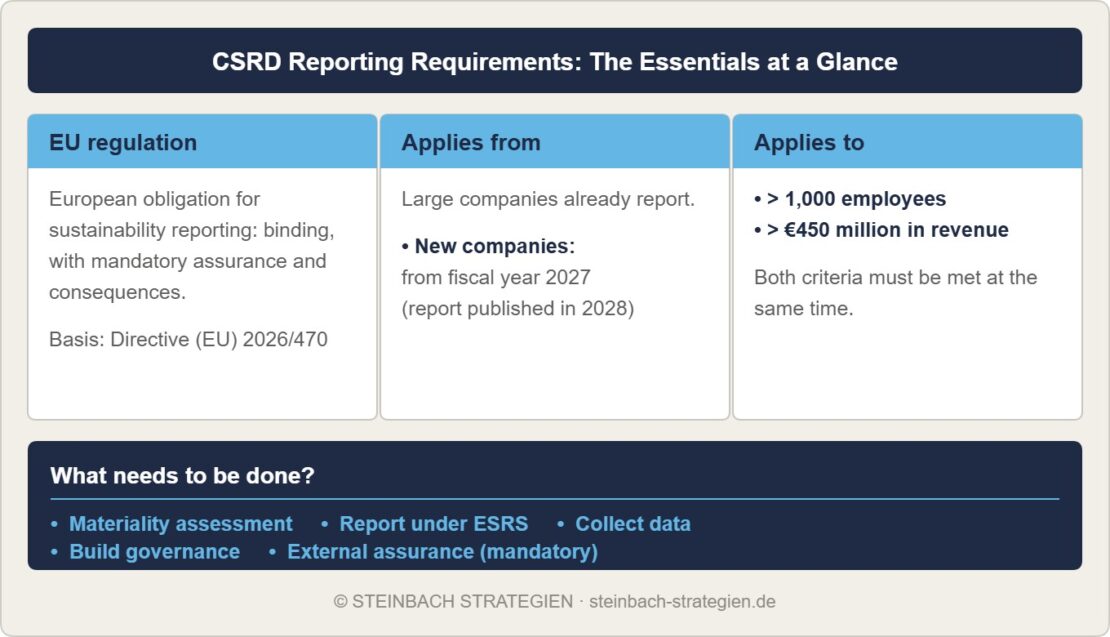
Fig.: CSRD reporting requirements: the key facts at a glance
Voluntary reporting and alignment of standards
Voluntary ESG reporting under the UN Global Compact, EcoVadis, CDP, or other standards makes strategic sense for many companies: it creates transparency for customers and investors and helps with answering customer questionnaires. Content and KPIs on topics such as climate, supply chain due diligence, human rights, biodiversity, and the circular economy are prepared and integrated into sustainability management. The challenge grows with the requirements: anyone who follows several standards in parallel, answers customer questionnaires, and serves ratings such as EcoVadis or the SAQ needs efficient processes, clear priorities, and synergies in sustainability reporting, beyond the CSRD reporting obligation as well.
Typical tasks
- Selecting and weighing reporting standards
- Analyzing customer questionnaires and setting up internal processes
- Setting up and optimizing reporting processes
- Creating synergies between different requirements and sustainability management
Frequently asked questions about sustainability reporting
It depends on whether there is a legal obligation and who reads the report. Companies subject to mandatory reporting report under the ESRS. For voluntary reports, GRI or the VSME standard are common.
Often, yes. Customers, banks, and investors request sustainability data, and a structured report answers many of these requests at once. It also creates internal clarity about targets, data, and responsibilities.
They all draw on the same data: energy, emissions, working conditions, supply chain. Building that data properly once means using it for the report, the rating, and the questionnaire, and avoiding duplicate work.
Get in touch
Questions? The best way to get started is with a brief email. A conversation then shows whether working together is a good fit and what it could look like.