EmpCo Directive Explained: New Rules for Your Advertising and Communication
| by Anke Steinbach | Share this post:
 no-repeat center center)
The EmpCo Directive has applied since September 27, 2026. Terms such as “climate neutral” or “environmentally friendly” are now even riskier than before. What is often less clear: What exactly can still be said, and what cannot? Who does it affect: only advertising, or other communication as well? And what needs to be done now?
Climate-neutral advertising has been ending up in court for years. The Wettbewerbszentrale (Centre for Protection against Unfair Competition) and Deutsche Umwelthilfe (Environmental Action Germany) send cease-and-desist letters to companies that advertise with unsubstantiated environmental claims, often successfully. In June 2024, Germany’s Federal Court of Justice (BGH) ruled: An ambiguous term such as “climate neutral” must be explained in the advertisement itself (in German). A reference to an external website is not sufficient. The EmpCo Directive has now written this strict line of case law into law. As a result, more players are likely to scrutinize corporate communication more closely.
EmpCo covers environmental claims made to consumers, regardless of format: text, image, label, or brand name. This also applies to wording that originally appeared in another document, such as a sustainability report. If a sentence moves from there unchanged onto a website or into a press release, it becomes subject to the directive. EmpCo takes a deliberately broad view of consumer communication.
First published on August 25, 2026, updated in November 2026: This article reflects the start of application on September 27, 2026, the current questions and answers from the European Commission, and developments regarding the Green Claims Directive.
In brief
- Since September 27, 2026, the EmpCo Directive has been binding in Germany, without a general transition period.
- It introduces five new prohibitions for environmental claims, four of them prohibited in all circumstances, without case-by-case assessment.
- Every claim accessible to consumers is affected: in advertising, on the website, in brochures, or on social media.
- Formally, the directive targets B2C communication, but B2B companies are affected too through the pass-through risk.
- Competitors and consumer associations can take direct action against violations with cease-and-desist letters.
The EmpCo Directive briefly explained
The EmpCo Directive (Directive on Empowering Consumers for the Green Transition, EU 2024/825) is part of the European Green Deal. It amends two existing legal acts, the Unfair Commercial Practices Directive and the Consumer Rights Directive. The EmpCo Directive entered into force in March 2024 and has been mandatory since September 27, 2026. Many companies are currently dealing with EmpCo alongside the CSRD and its reporting requirements. The two apply at different points, however. The CSRD requires ESG reporting to the market and stakeholders. EmpCo governs how companies may communicate about environmental aspects to consumers.
How Germany transposed the EmpCo Directive into the UWG
Germany transposed the directive into the German Act Against Unfair Competition (UWG) (in German) in February 2026, promulgated in the Federal Law Gazette on February 19, 2026 (BGBl. 2026 I No. 43). The new prohibitions are added as entries to the blacklist in Section 3(3) UWG. A second act regulates additional information requirements on durability and reparability, which is only marginally relevant for environmental claims.
The blacklist works differently from the usual assessment under Section 5 UWG. Normally, a court assesses each case individually: Is the claim misleading? In what context does it appear? For four of the five new prohibitions, this case-by-case assessment no longer applies: they are prohibited in all circumstances. Proof that the prohibited practice has occurred is sufficient. Only for future environmental claims does the case-by-case assessment remain. This makes the blacklist effective, but also risky for companies. The next section shows which five practices are prohibited.
What counts in practice is the date of application. Formally, the transposition into the UWG was completed in February 2026. The new prohibitions have applied since September 27, 2026, without a transition period. Since then, any environmental claim still in active use can be challenged with a cease-and-desist letter, for example on the website, on packaging, or in ongoing advertising.
Five prohibitions on the EmpCo Directive blacklist
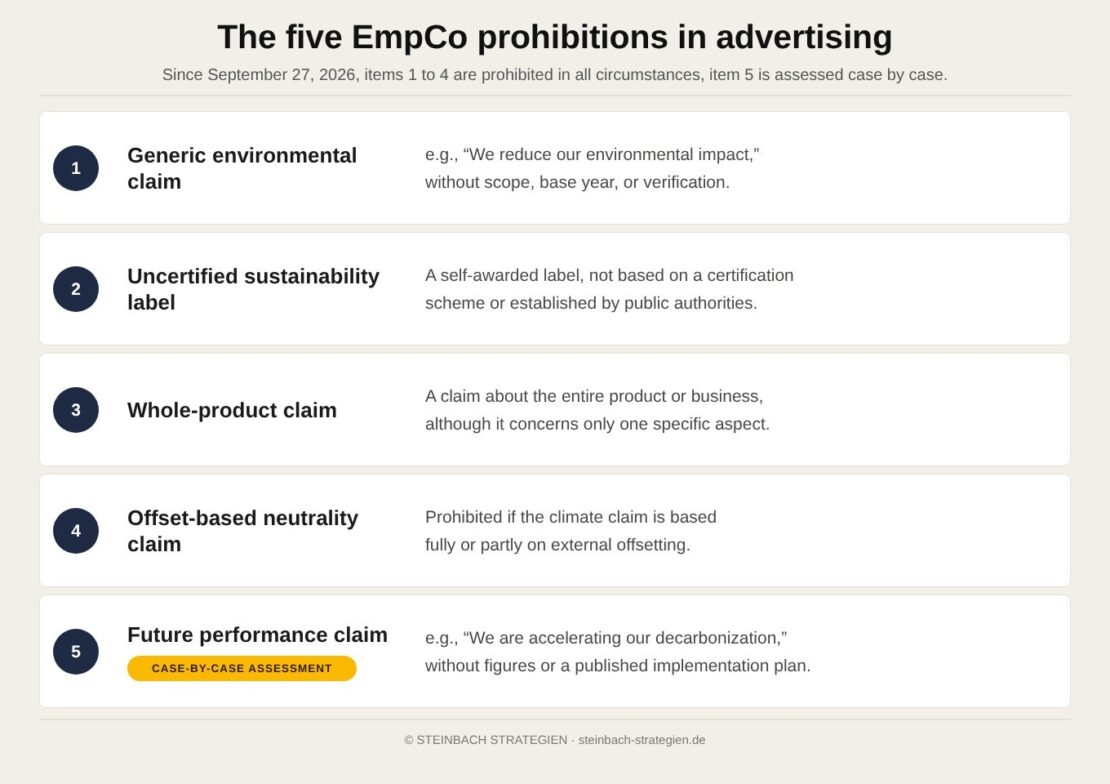
The EmpCo Directive brings five key prohibitions for environmental communication. They include blanket environmental claims without evidence and self-developed sustainability labels without independent certification.
- Generic environmental claims such as “green,” “environmentally friendly,” or “climate neutral” are prohibited if no recognized excellent environmental performance can be demonstrated.
- Sustainability labels that are not based on a certification scheme (such as ISO 14024) or established by public authorities may no longer be used.
- Claims about the entire product or company are prohibited if the underlying performance concerns only one aspect, such as a single product line or a single site. The claim remains permissible if it clearly names the aspect concerned, for example “The packaging is made from 100 percent recycled material.”
- Communication about product-related climate neutrality is prohibited if it is based fully or partly on offsetting outside the company’s own value chain. Carbon credits are no longer sufficient as evidence for a neutrality claim. It remains permissible to state that actual emissions within the company’s own value chain have been reduced.
- Future environmental claims such as “climate neutral by 2030” are only permissible with a concrete plan. Unlike the other four prohibitions, proof that the claim was made is not enough here: each case is assessed individually. The assessment looks at whether there is a plan with measurable, time-bound targets and a path to achieving them. This plan must be publicly available and regularly reviewed by an independent party.
Which environmental claims are risky under the EmpCo Directive?
Some phrases sounded harmless for a long time and are now a risk:
- Energy efficient
- Saves resources
- Reduces the ecological footprint
- Durable and sustainable
- Uses less energy
Each of these claims now deserves a closer look.
The reason lies in a distinction that now determines whether a claim is permissible: generic claim or claim with evidence. A generic claim asserts an environmental benefit without substantiating it. It is only permissible if it is backed by “recognized excellent environmental performance.” This means above-average performance demonstrated through an official system, for example the EU Ecolabel or a high energy efficiency class such as A or B.
For “energy efficient,” this means: The claim is allowed if the product actually achieves this efficiency class under EU Regulation 2017/1369 on energy labeling. Without this evidence, it remains prohibited, no matter how technical or harmless it sounds. The same logic plays out differently from claim to claim. “Biodegradable” has no regulation of its own like “energy efficient.” The only route would be the EU Ecolabel, and only if it contains criteria on biodegradability for the relevant product category. For most products, that is not the case, so in practice the claim usually remains prohibited.
Words such as “more efficient,” “improvement,” or “less” also count as environmental claims. They assert a change compared with a reference value and therefore require evidence as well.
Applied to the examples: “Energy efficient” is only permissible if a specific, verified efficiency class backs it up. “Saves resources,” “Reduces the ecological footprint,” and “Uses less energy” are prohibited generic claims without this evidence. “Durable and sustainable” mixes both: Durability can often be proven technically, while “sustainable” is one of the generic claims that fall under prohibition 1 anyway.
When are comparative environmental claims permissible under the EmpCo Directive?
Comparative claims carry a risk of their own because the basis for comparison is rarely provided. “More environmentally friendly than conventional solutions” sounds like a statement, but provides no verifiable information: What is being compared, at what point in time, and by what method remains open. Here, the EmpCo Directive requires an objective basis with a consistent method and consistent assumptions. An example such as “30 percent lower energy consumption than the 2023 industry average” only meets this requirement with a citable source in the background, such as industry association statistics or an independent study. Without this source, the year remains an unsupported claim with a date. A blanket best rating without any reference value falls short of the requirement anyway.
Similar gaps arise in comparisons with a company’s own predecessor product or with “comparable products on the market”: Which predecessor model, which competitor products, and which measurement method often remain open. Some companies therefore avoid the comparison altogether and describe a pure attribute instead, such as “particularly high energy efficiency.” That still leaves the problem in place: Without a reference value, it quickly becomes a generic claim as soon as it suggests excellent environmental performance without substantiating it.
When is “climate neutral by 2030” a permissible claim?
Future claims follow a similar logic, but by a different route. Instead of an automatic ban as with the other prohibitions, a case-by-case assessment decides here. Anyone who writes “We are accelerating our decarbonization” or “climate neutral by 2030” needs a publicly available, measurable plan with interim targets and independent monitoring. Without the plan, the announcement becomes a prohibited claim. If the path there is based fully or partly on offsetting outside the company’s own value chain, the offset neutrality prohibition also applies, regardless of whether a plan exists.
Many companies already have the content for such a plan, but for EmpCo it needs to be compiled and published. The documentation usually pays off beyond that, for example in communication with customers. A linkable PDF on the website is the simplest form. For many companies, the critical point in terms of timing is the review: EmpCo requires the published plan to be objectively assessed and confirmed by an independent party. A qualified, independent party is sufficient for this. An auditor is not a mandatory requirement.
Why the EmpCo Directive also affects B2B companies
Formally, EmpCo applies in a B2C context. It targets communication with consumers, not business between companies. Still, the directive is just as relevant for B2B companies, for two reasons. First, customers of B2B suppliers, often B2C companies themselves, adopt their suppliers’ sustainability claims in their own communication. If the underlying claim is not compliant, the downstream communication becomes a risk. Second, B2B websites are accessible to consumers as well and are classified accordingly. Competitors, too, are increasingly checking which sustainability claims a company makes about its products. B2B companies should therefore check their claims for EmpCo compliance just as carefully as B2C companies.
What should companies do now that the EmpCo Directive applies?
For packaging, classic advertising claims, and campaigns, most companies did their homework before September 27, 2026. The longer lead times and the direct economic consequences prompted marketing and communications teams to act early.
Two further areas now deserve a closer look. The first is the website: Where are critical or vulnerable claims? This sounds more complicated than it is. The five prohibitions set a clear framework, and communication has to measure up to it. In several projects over recent months, STEINBACH STRATEGIEN has developed a practical approach for this. Within a few days, there is a concrete to-do list of what comes off the website and what needs to be reworded, and how.
Legal certainty on EmpCo remains a task for legal counsel. STEINBACH STRATEGIEN provides the practical groundwork. Many years of experience from sustainability projects and a feel for language make critical passages visible with a high degree of probability. The rough spots can be cleaned up, the team gains awareness, and the result is tangible and actionable.
The second area is publications in the broader sense. When preparing a sustainability report, an integrated annual and sustainability report, or similar publicly accessible publications, EmpCo should be considered from the outset. Existing sales brochures, product descriptions, and data sheets should be reviewed and adjusted step by step as well.
The EmpCo projects of recent months have shown how helpful a concrete communication guide for the company is. Instead of explaining EmpCo in general terms, the guide translates the requirements directly into the company’s own communication practice: Which claims can we no longer use? What needs to be communicated differently? Where is caution needed? This gives employees in marketing, sales, and corporate communications concrete guidance in their day-to-day work. Review by the company’s own legal team remains important nonetheless, as it provides the legal certainty that the guide itself cannot replace. This guidance remains in demand after September 27, 2026: New campaigns, products, and publications must continuously measure up to the five prohibitions.
The following questions and answers supplement the official questions and answers from the European Commission (as of September 2026), adapted to practice in Germany.
Frequently asked questions about the EmpCo Directive
Since September 27, 2026, EU-wide and in Germany. The German transposition into the UWG was already promulgated on February 19, 2026. The new prohibitions have applied since that date without a general transition period.
The word itself is not prohibited. The claim becomes prohibited if it is generic and unsubstantiated, or if the neutrality is based fully or partly on offsetting outside the company’s own value chain. In practice, the term therefore often touches on one of these two prohibitions.
Companies may continue to communicate openly about offsetting measures, for example about investments in certified climate protection projects. It only becomes prohibited when climate neutrality of the product or company is derived from them and is based fully or partly on offsetting outside the company’s own value chain.
No. In 2024, the Federal Court of Justice ruled that the explanation of an ambiguous environmental term must appear in the advertisement itself. A reference to an external page is not sufficient.
The Green Claims Directive is a separate EU initiative that was intended to introduce mandatory prior verification of voluntary environmental claims. Negotiations have been on hold since mid-2025. In November 2026, the European Commission announced in its 2027 work programme that it would withdraw the proposal within six months. The EmpCo Directive is independent of this and already applies.
Four of the five prohibitions apply without case-by-case assessment, which is sufficient for a cease-and-desist letter. Action is never automatic, though: It takes a competitor, an association, or another entity entitled to bring an action to actually assert a violation. Without such proceedings, a violation initially has no consequences, but the risk has existed since September 27, 2026, without any grace period.
Conclusion
Implementing the EmpCo Directive remains an ongoing task
Since September 27, 2026, a clear standard has applied to a company’s environmental claims made to consumers: five prohibitions, four of them without case-by-case assessment. All sustainability communication therefore needs to be put to the test consistently. Every new campaign, every new product communication, and every publication must measure up to the five prohibitions, in B2C as well as B2B business.
STEINBACH STRATEGIEN supports companies in reviewing their website and publications for critical claims and in developing an internal guide for sustainability communication. For an expert look at your communication, feel free to get in touch.